Freshwater Wildlife Identification: A Beginner's Guide
How to recognise common pond and river invertebrates, fish, amphibians, birds, mammals and plants, which keys to use, and how to look safely and legally.
Lift a net from a pond in spring and tip it into a white tray, and within seconds the water comes alive: something with three feathery tails darts across the bottom, a curled grey creature swims on its side, a snail glides along the edge, and a fierce-looking larva with a hinged jaw waits motionless in the corner. For a beginner, the challenge is not finding wildlife in fresh water. It is knowing what you are looking at.
The good news is that you do not need to name every species. Most freshwater wildlife can be sorted into a manageable number of groups using a few clear features, and that is enough to understand a pond or stream and even to judge its water quality. Naming to species level can come later.
This guide covers the main groups of freshwater animals and plants you are likely to see in Britain and much of Europe, the features that separate them, the identification tools that help, and the rules for looking at wildlife safely, kindly and legally. It belongs with our guide to freshwater ecosystems for students.
Safety: Children must always be with an adult near water, and young children within arm's reach. Use gentle, shallow, stable edges, keep away from fast, deep or cold water and steep banks, and check flood warnings. The NHS explains that leptospirosis (Weil's disease) can be caught when fresh water or soil contaminated with animal urine gets into the mouth, eyes or a cut, so cover cuts with waterproof plasters, do not eat near the water, and wash hands with soap afterwards.
How to identify: start with groups
Identification is a process of narrowing down. Ask simple questions in order:
- How many legs does it have? Six jointed legs means an insect (adult or larva). More than six means a crustacean, mite or spider. None at all means a worm, leech, snail, fly larva or something else.
- Does it have a shell or case? Snails and limpets have shells; many caddis larvae build portable cases.
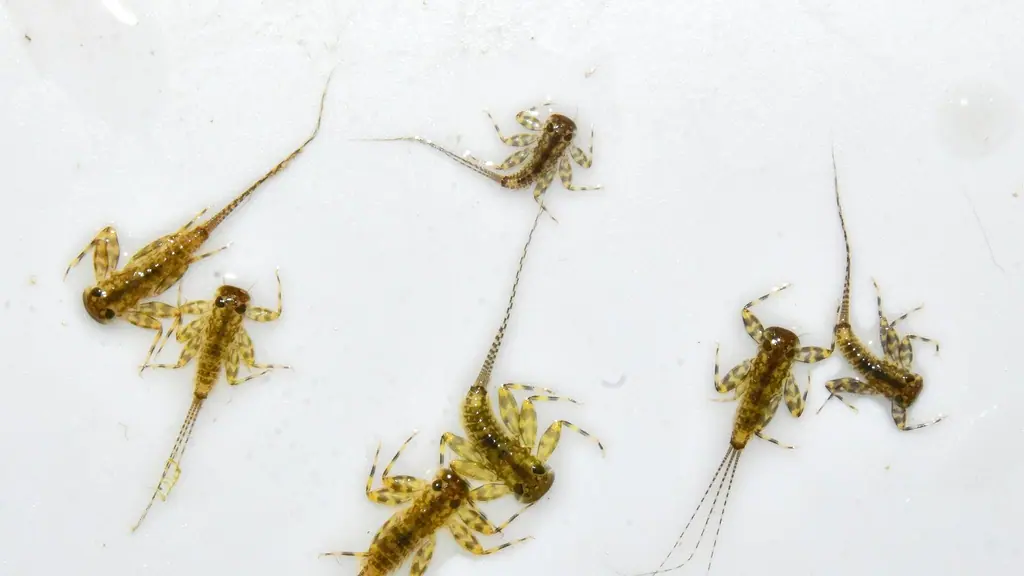
- How many tails, and what shape? Tails are one of the most useful features for insect nymphs.
- How does it move? Swimming on its side, rowing upside down, skating on the surface, looping like a caterpillar: movement is often the quickest clue.
- Where was it? On stones in a current, among weed, on the surface or in mud.
Fold-out keys work in exactly this way. The Field Studies Council's Freshwater Name Trail, for example, guides users through a series of yes-or-no questions to the main groups of pond and stream animals, and includes a fact file about each group and a simple pollution index calculated from pond-dipping results.
Invertebrates: the animals in the net
Invertebrates are the animals you will find most often. The table gives key features for common groups.
| Group | Key features | Where |
|---|---|---|
| Mayfly nymph | Six legs; usually three thin tails; gills along the sides of the abdomen | Streams and ponds |
| Stonefly nymph | Six legs; two tails; no gills along the abdomen; often flattened | Clean, stony streams |
| Caddisfly larva | Soft, caterpillar-like body; six legs at the front; many build cases of sand, stones or plant pieces | Streams and ponds |
| Damselfly nymph | Slim; three leaf-like plates (gills) at the tail end | Ponds and slow water |
| Dragonfly nymph | Stocky; no tail plates; hunts with an extending lower "mask" jaw | Ponds and slow water |
| Water boatman (lesser) | Rows the right way up with long, oar-like back legs; often near the bottom | Ponds |
| Backswimmer | Swims upside down just below the surface; can give a painful bite, so do not handle | Ponds |
| Pond skater | Long legs; skates on the water surface | Still and slow water |
| Diving beetle | Hard, smooth wing cases; often comes up to collect air at its rear end | Ponds |
| Freshwater shrimp | Curved, flattened sideways; often swims on its side | Streams, clean ponds |
| Water hoglouse (water slater) | Flattened from top to bottom, like a woodlouse; walks over mud and leaves | Ponds and slow streams, including enriched water |
| Pond snails | Coiled or pointed shells; ramshorn snails have flat, coiled shells | Ponds and slow water |
| Leeches | Segmented, with a sucker at each end; move by looping | Ponds and streams |
| Midge larvae (bloodworms) | Thin, worm-like; some are bright red | Mud, often in low-oxygen water |
Some of these groups are sensitive to pollution and some tolerant. Stonefly nymphs, many mayfly nymphs and cased caddis larvae generally need clean, well-oxygenated water, while water hoglice, bloodworms and leeches can survive in poorer conditions. Volunteers use this principle in river monitoring; our guide to looking for river invertebrates explains kick sampling and simple scores.
Key idea: Count the legs, check for tails, cases and shells, and watch how it moves: those few clues will sort most pond and stream animals into the right group.
Amphibians
Britain has a small number of native amphibians, and the commonest are easy to tell apart.
- Common frog: smooth, moist skin, usually olive-green or brown but very variable in colour. Froglife lists dark patches on the back, stripes on the hind legs and a dark "mask" behind the eye as key features. Frogs lay their spawn in clumps, from January in south-west England onwards.
- Common toad: warty, relatively dry skin; tends to crawl rather than hop; many have a golden iris. Toads lay long strings of spawn containing a double row of eggs, wrapped around water plants, usually a little later than frogs.
- Newts: lizard-shaped amphibians with tails. The smooth newt and palmate newt are widespread. The great crested newt is larger, with dark, warty skin and an orange belly with black blotches; in the breeding season males have a tall, jagged crest.
A protected species
Great crested newts are strictly protected in Britain. Government guidance explains that, under the Conservation of Habitats and Species Regulations 2017, it is an offence to deliberately capture, injure, kill or disturb them, to destroy their eggs, or to damage or destroy their breeding sites and resting places. Surveys require a licence. If you think you have seen one, do not catch it: take a photo if you can do so without disturbing it, and report it to your local biological records centre or wildlife trust.
Fish
Fish are harder to see clearly, but a few features help:
- Three-spined stickleback: small, with three sharp spines on its back; breeding males have a red throat.
- Minnow: small, slim, often in shoals in clean streams, with a row of dark blotches along the side.
- Bullhead: small, with a broad, flattened head; lives under stones on the stream bed.
- Brown trout: spotted, with a small fleshy fin (the adipose fin) between the back fin and the tail.
- Perch: greenish with dark vertical stripes and a spiny front dorsal fin.
- Pike: long, with a duck-like snout and its dorsal fin set far back near the tail.
Fishing for and handling fish is regulated in most countries; observe fish rather than catching them unless you are taking part in an organised, licensed activity.
Birds and mammals
Birds are the easiest freshwater animals to watch:
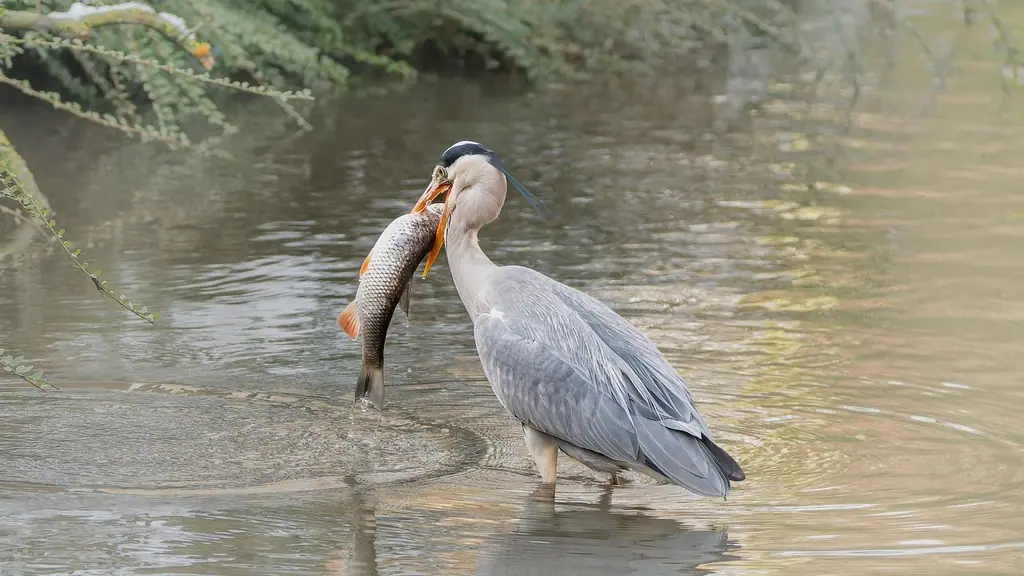
- Grey heron: tall, grey, standing motionless in the shallows.
- Kingfisher: small, brilliant blue and orange, usually seen as a flash low over the water.
- Dipper: dark brown with a white bib; bobs on stones in fast streams and walks under water to feed.
- Moorhen: dark, with a red-and-yellow bill; coot: black with a white bill and forehead shield.
- Mallard: the familiar duck; males have a green head in most of the year.
Mammals are shy, so look for signs. Otters leave tracks and distinctive droppings (spraints) on rocks and logs. Water voles are rounder than rats, with a blunt face, small ears and a shorter, furry tail; you may hear a "plop" as one dives. Water voles are protected under the Wildlife and Countryside Act 1981: government guidance makes it an offence to kill, injure or take them, or to damage, destroy or block access to their burrows or disturb them while they are using them. Watch from a distance and never disturb burrows.
In North America, many of the same groups are found, with different species: belted kingfishers, great blue herons and American bullfrogs, for example, alongside mayflies, caddisflies and dragonflies.
Plants
Water plants are grouped by how they grow:
- Emergent plants root in shallow water with stems and leaves above the surface: common reed, reedmace (often called bulrush), yellow flag iris and marsh marigold.
- Floating-leaved plants root in the bed with leaves on the surface: water-lilies and some pondweeds.
- Free-floating plants drift on the surface: duckweeds.
- Submerged plants grow mostly underwater: hornworts, water-milfoils and starworts. Water-crowfoots, with white buttercup-like flowers, form beds in clear, flowing rivers and in ponds.
Some non-native plants spread aggressively along rivers and ponds, so learning to recognise them is useful; national non-native species bodies publish identification sheets.
Tools and good practice
Useful kit: a pond net with a long handle, a white tray, a few small clear pots, a hand lens, a spoon or soft paintbrush for moving small animals, a field guide or fold-out chart, and a notebook or phone for photos and records.
Look, don't take. Follow these rules every time:
- Sweep the net gently through weed or along the bottom; do not dig up the bed.
- Keep animals in shaded water from the same place for minutes, not hours, and separate large predators such as dragonfly nymphs and diving beetles from small prey.
- Handle animals as little as possible, with wet hands or a spoon; never squeeze them. Do not handle amphibians unnecessarily, and never handle great crested newts, white-clawed crayfish or water voles.
- Return everything gently to where you found it, including plants and spawn.
- Check, clean and dry your net, tray and boots before visiting another site, so you do not spread diseases or invasive species between waters.
- Wash your hands with soap and water afterwards.
Record what you find. Records help scientists track how species are faring. Submit sightings to your local records centre or a national recording scheme, or join freshwater citizen science projects.
To see how these animals depend on one another, read freshwater food chains and food webs; for the best places to look, see ponds: small waters with big value. Browse more in our freshwater ecosystems and wildlife section.
Sources
- Freshwater name trail (identification chart)Field Studies Council
- Common FrogFroglife
- Common ToadFroglife
- Great crested newts: advice for making planning decisionsNatural England and Department for Environment, Food & Rural Affairs
- Water voles: advice for making planning decisionsNatural England and Department for Environment, Food & Rural Affairs
- Leptospirosis (Weil's disease)NHS
Spotted an error? Write to contact@freshwateraction.net. Our editorial policy explains how we correct articles.