Peatlands: The Wetlands That Store Carbon
How bogs and fens form peat, why waterlogged ground locks up so much carbon, what happens when peatlands are drained or burned, and how rewetting restores them.
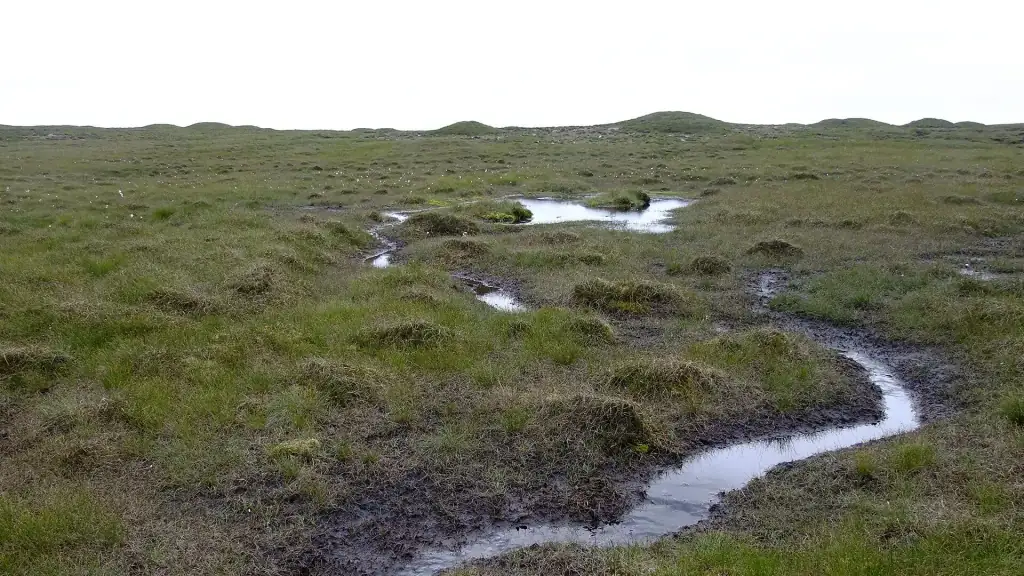
Cut a spade into a healthy bog and the hole fills with brown water almost at once. Pull out a block of the dark, fibrous soil beneath and you can often still see the stems and leaves of the mosses and sedges it is made from. That is peat: plant material that has died but never fully rotted, because the ground has been too wet for it to decompose. In places, layer upon layer has built up over thousands of years into deposits several metres deep.
Because peat is mostly the remains of plants, and plants are made largely from carbon taken out of the air, peatlands are enormous carbon stores. The International Union for Conservation of Nature (IUCN) calls them the largest natural carbon store on land: peat soils cover at least 3 per cent of the world's land surface yet contain more than 600 gigatonnes of carbon, more than all other vegetation types in the world combined, including forests.
This article explains how peat forms, the main kinds of peatland, why drained peatlands become sources of greenhouse gases, and how restoration works, with examples from the UK. For the wider picture of wetlands, start with our guide to wetlands and biodiversity.
How peat forms
Peat forms wherever plants grow faster than they decay. In most soils, fungi and bacteria break dead leaves and roots down within a few years, returning their carbon to the air as carbon dioxide. In waterlogged ground, the spaces between soil particles are filled with water instead of air, oxygen runs short, and decomposition slows dramatically. As the IUCN brief puts it, year-round waterlogged conditions slow plant decomposition, so dead plants accumulate to form peat.
England's Peat Action Plan, published by Defra in 2021, uses a standard definition: peatlands are "areas of land with a naturally accumulated layer of peat, formed from carbon rich dead and decaying plant material under waterlogged conditions". Peat accumulates very slowly, so a deep bog represents thousands of years of growth that cannot be quickly replaced once lost.
In many bogs the key plants are sphagnum mosses, which the IUCN UK Peatland Programme describes as typically carpeting healthy bogs in a pattern of hummocks and hollows. A healthy bog is, in effect, a self-sustaining system: the living, waterlogged surface maintains the conditions that preserve the dead layers beneath.
Key idea: Peat is partly decayed plant matter preserved by waterlogging. Keep a peatland wet and it stores carbon for millennia; drain it and the stored carbon starts returning to the air.
Bogs and fens
Peatlands are often divided into two basic kinds according to where their water comes from. The IUCN UK Peatland Programme describes them as water-shedding systems fed mainly by rain and snow (ombrotrophic bogs) and water-receiving systems fed mainly by surface water and groundwater (minerotrophic fens).
| Bogs | Fens | |
|---|---|---|
| Main water source | Rain and snow | Groundwater and surface water, as well as rain |
| Chemistry | Acidic and very nutrient-poor | Less acidic; nutrient status varies from poor to rich |
| Typical plants | Sphagnum mosses, cottongrasses, heather, sundews, bog rosemary, cranberry | Sedges, reeds, rushes, tall herbs and, in base-rich fens, orchids and brown mosses |
| UK forms | Blanket bog on uplands; raised bog in lowlands | Lowland fens, valley fens, upland flushes |
Source: IUCN UK Peatland Programme, UK Peatland Habitats briefing (December 2025).
The UK has three broad peatland types:
- Blanket bog stretches across flat and moderately sloping upland ground where rainfall exceeds water loss, typically over acidic rock. The IUCN UK briefing describes the Flow Country of northern Scotland as the most extensive and diverse example of an actively accumulating blanket bog in the world, and the only UNESCO World Heritage Site inscribed purely for its peatland qualities.
- Raised bog forms localised domes of peat rising several metres above the surrounding lowland. Many began as lakes or fens that slowly filled with peat until their surface rose beyond the reach of groundwater and became rain-fed.
- Fen receives water from both rain and groundwater. Fens are less acidic than bogs and very rich in species: the briefing notes that they support around a third of all native plant species in the UK and half of all dragonfly species.
Why drained peat releases carbon
For centuries, peatlands have been drained for farming, forestry and peat extraction, burned to manage moorland, and cut for fuel and garden compost. Draining a peatland lets air into the peat. Microbes that had been held back by the lack of oxygen can then break down the stored plant material, releasing carbon dioxide. Dried peat also shrinks and erodes, washing into streams as particles and dissolved organic carbon, and it is more likely to burn.
The scale is global. The IUCN brief estimates emissions from drained and degraded peatlands at about 1.9 gigatonnes of carbon dioxide equivalent a year, equivalent to around 5 per cent of global human-caused greenhouse gas emissions, even though damaged peatlands cover only about 0.3 per cent of the world's land. It notes that in some regions up to 80 per cent of peatlands have been damaged. Fires in drained tropical peat swamps can be especially severe: the brief reports that Indonesia's 2015 peat fires released nearly 16 million tonnes of carbon dioxide a day.
In numbers: Peat soils cover at least 3 per cent of the world's land surface but hold more than 600 gigatonnes of carbon, up to 44 per cent of all soil carbon.
Source: IUCN, Peatlands and climate change issues brief.
Peatlands in England and the UK
In the UK, the IUCN UK Peatland Programme states that only around 20 per cent of peatlands remain in a near-natural state.
England's Peat Action Plan gives a more detailed picture for England:
- There are approximately 1,420,000 hectares of peatland in England, of which deep peat (more than 40 cm thick) accounted for 677,250 hectares when originally mapped.
- Only 13 per cent of England's deep peat area remains in a near-natural state.
- England's peatlands are estimated to emit approximately 10 million tonnes of carbon dioxide equivalent a year.
- Lowland peat used for intensive agriculture covers less than 4 per cent of England's farmed area but produces more than 7 per cent of England's agricultural output, which is why restoring it involves difficult choices.
In 2025, Natural England published a new peat map for England. Its blog post on the map estimates emissions from degraded peat soils at about 2 per cent of England's total emissions and 3.5 per cent of the UK total, and reports that around three-quarters of England's peatlands are covered by plants and land uses associated with drier conditions, with only 1 per cent dominated by sphagnum mosses.
Peatlands matter for more than carbon. The Peat Action Plan notes that they hold some of England's rarest species, such as bitterns, swallowtail butterflies, sundews, hen harriers and short-eared owls, and that many upland catchments supplying drinking water are peat-covered. As degraded peat releases dissolved organic carbon, it discolours the water, which then has to be treated to remove the colour.
Restoring peatlands
The core of peatland restoration is simple to describe: make it wet again. The IUCN brief defines restoration as reviving the waterlogged conditions required for peat formation. In practice, that involves:
- Blocking drains and gullies with peat dams, timber or stone so that water is held on the bog instead of running off.
- Revegetating bare peat by spreading heather brash, nurse grasses or plugs of sphagnum moss, so that the surface stops eroding.
- Removing trees planted on deep peat, where they dry the surface, and re-profiling the edges of old peat cuttings.
- Changing land management, for example reducing burning and grazing pressure on upland bogs, or raising water tables on lowland farmland where feasible, sometimes with crops suited to wet conditions.
Rewetting takes time to show its full results, but by keeping the peat wet it slows or halts the loss of stored carbon and allows bog plants and wildlife to return. IUCN describes peatland restoration as cost-effective and as one of the few land-based ways to store carbon indefinitely. England's Peat Action Plan, published in 2021, committed to funding at least 35,000 hectares of peatland restoration by 2025 and set out plans to ban the sale of peat for amateur gardening.
What you can do
Safety: Bogs can hide deep pools and very soft ground beneath the vegetation. Stay on marked paths and boardwalks, keep children close, check the weather in the hills, and wash hands with soap after touching bog water or peat.
- Garden peat-free. Choose peat-free compost and growing media. England's Peat Action Plan notes that the amateur sector makes up around 70 per cent of UK horticultural peat use.
- Stay on paths when walking on moorland and bogs, which protects fragile vegetation and keeps you safe from deep, soft ground.
- Prevent fires. Never light barbecues or fires on moorland, especially in dry spells.
- Look closer. Learn to recognise sphagnum mosses, cottongrass and sundews, and support local peatland restoration projects as a volunteer.
To see how peat-forming fens and bogs fit among other wetland types, read about the Ramsar Convention, which protects many of the world's most important peatlands, and ponds. For how peatlands fit into the wider picture of a warming world, see climate change and freshwater, or browse our wetlands section.
Sources
- Peatlands and climate change (issues brief)International Union for Conservation of Nature (IUCN)
- UK Peatland Habitats (briefing, December 2025)IUCN UK Peatland Programme
- UK PeatlandsIUCN UK Peatland Programme
- England Peat Action PlanDepartment for Environment, Food & Rural Affairs (Defra)
- A new peat map for EnglandNatural England
Spotted an error? Write to contact@freshwateraction.net. Our editorial policy explains how we correct articles.