Rainwater Harvesting: A Practical Introduction
How rainwater harvesting works, from a water butt to a whole-house system: estimating your roof's yield, safe non-drinking uses and the rules to check first.
Every millimetre of rain that falls on one square metre of roof is one litre of water. That simple conversion explains why rainwater harvesting appeals to gardeners and builders alike. The Royal Horticultural Society (RHS) points out that in dry south-east England, the roof of a small shed can collect 2,500 to 3,500 litres of rain a year, enough to fill around ten to fifteen standard 240-litre water butts. A house roof collects many times more.
Collected rainwater is free, soft and low in minerals; the RHS calls it the best option for watering gardens. Harvesting it reduces the demand on treated mains water, and storing it during storms holds back a little of the runoff that would otherwise rush into drains. But stored water also brings responsibilities: it is not safe to drink without treatment, it must never be connected directly to the mains, and in some places the right to collect it is regulated.
This guide explains how systems work, from a single water butt to a whole-house tank, how to estimate how much water your roof can supply, which uses are safe, and what to check before you start. It complements our wider guide to how to save water at home.
How a rainwater system works
Every system, however large, has the same parts:
- Catchment: usually a roof. Smooth, clean, pitched roofs shed water best.
- Conveyance: gutters and downpipes carry the water.
- Filtering: a leaf guard, filter or diverter keeps out leaves, grit and the dirtiest first rinse of the roof.
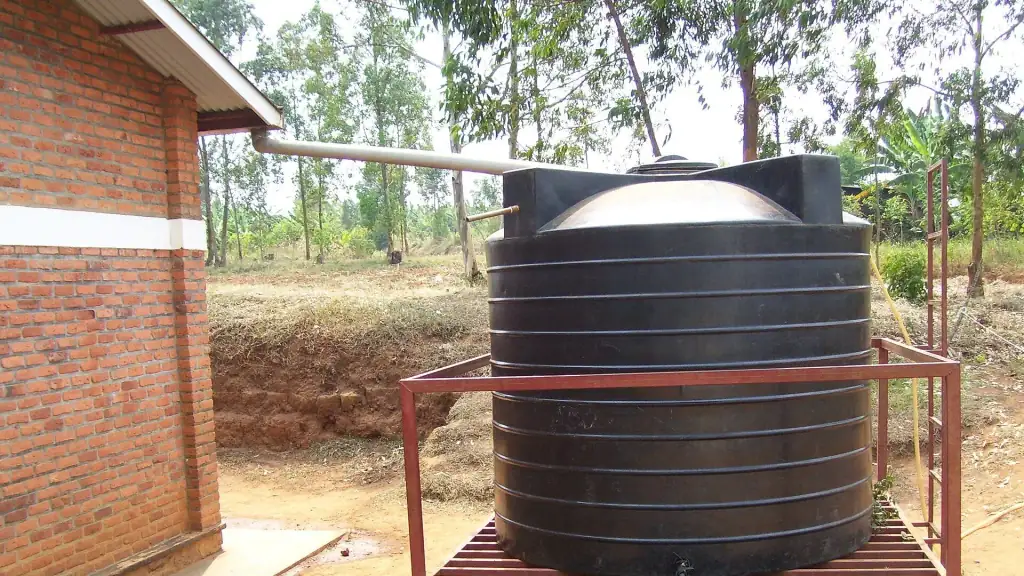
- Storage: a water butt, linked butts, or an above- or below-ground tank.
- Distribution: a tap and watering can, a pump and hose, or, in whole-house systems, a separate pipe network to toilets and the washing machine.
- Overflow: a route for excess water when the store is full, to a drain, soakaway or rain garden.
Water butts
The simplest system is a water butt fitted to a downpipe with a diverter kit. The RHS recommends placing butts on firm, level stands so a watering can fits under the tap, fitting a filter to keep out leaves, linking several butts with connector kits where space allows, and covering each with a close-fitting lid to keep out disease spores and discourage algae. It also advises cleaning butts once a year with warm water and a little washing-up liquid, and emptying and cleaning one that smells rather than adding chemicals.
Whole-house systems
Larger systems store rain in a tank, often buried, and pump it to toilets, washing machines and outside taps. Because toilets and laundry account for a large share of indoor use, these systems can replace a substantial amount of mains water, but they cost more, need power for pumps, and must be designed and installed to plumbing regulations.
How much water can your roof collect?
A first estimate needs three numbers:
Annual yield (litres) = roof area (m²) × annual rainfall (mm) × runoff coefficient
- Roof area is the footprint the roof covers seen from above, not the area of its sloping surfaces. Measure the length and width of the building, including overhangs.
- Annual rainfall comes from your national weather service's long-term averages for your area.
- Runoff coefficient accounts for water lost to splashing, evaporation, absorption and the first rinse diverted by filters. The University of Warwick's Development Technology Unit notes that it varies between 0.5 and 0.9 depending on roof material and slope; smooth, steep roofs sit at the top of that range, and flat or rough roofs lower.
Try this: Imagine a house with a roof footprint of 50 m² in a place that receives 600 mm of rain a year. Using a runoff coefficient of 0.8: 50 × 600 × 0.8 = 24,000 litres a year. That is the water that reaches the gutters; how much you can actually use depends on how much you can store and when you need it. Repeat the sum with your own roof and local rainfall.
The catch is timing. In many temperate climates more rain falls in winter, when gardens need least, so a full butt overflows for months and runs dry in a summer drought. Sizing a system means balancing roof yield, storage and demand through the year; the Warwick unit lists local rainfall patterns, collection area, runoff coefficient, user numbers and consumption rates as the factors that determine storage requirements. For a garden, several linked butts are usually more useful than one large one in the wrong place.
Safe uses, and why rainwater is not for drinking
Rain is clean when it forms, but by the time it has run over a roof and through gutters it can carry dust, leaves, moss, droppings from birds and other animals, and substances from roofing materials. Stored for weeks, it can also grow bacteria and algae. That is why collected rainwater in homes is used only for non-drinking purposes unless it is professionally treated and monitored.
| Use | Suitable for untreated rainwater? |
|---|---|
| Watering established garden plants, lawns and houseplants | Yes |
| Watering seedlings | Better avoided: the RHS warns stored water may carry damping-off diseases |
| Washing cars, windows and garden tools | Yes |
| Flushing toilets, washing machines | Yes, in a properly designed and installed system |
| Drinking, cooking, brushing teeth, washing food | No |
| Filling paddling pools or bathing | No |
| Watering edible crops | Use with care; avoid splashing leaves of salad crops eaten raw |
Safety: Never drink harvested rainwater or use it for cooking, brushing teeth or filling paddling pools. Fit every butt and tank with a secure lid that young children cannot open, because a child can drown in a butt or tank, and never leave young children alone near stored water. Use a coarse spray rather than a fine mist if you use a hose from a butt, keep tanks cool and shaded, and do not let water stand unused for long periods in warm weather.
Two hazards deserve particular attention:
- Legionella. The bacteria that cause Legionnaires' disease, a potentially fatal form of pneumonia, grow in water between 20 and 45 °C, according to the UK Health and Safety Executive, and people are infected by breathing in fine droplets. The RHS likewise warns that breathing in droplets from stagnant, warm water can pose a health risk, and recommends a coarse spray setting on hoses connected to water butts. Keeping stored water cool, used regularly and away from fine sprays reduces the risk.
- Mosquitoes. Open water is a breeding site. The US Centers for Disease Control and Prevention advises tightly covering water storage containers such as cisterns and rain barrels, and using wire mesh with holes smaller than an adult mosquito on any container without a lid. This matters most where mosquitoes carry disease, but a sealed lid is good practice everywhere.
Rules to check before you start
Rainwater law differs greatly between countries and even between neighbouring states, so check locally before installing anything bigger than a garden butt.
- United Kingdom. The RHS notes that collecting rainwater from roofs is legal and encouraged by councils and water companies. The Environment Agency's regulatory position statement says it will not regulate harvested rainwater provided its use does not harm the environment, and that you do not need an abstraction licence to use water that consists only of harvested rainwater, although combining it with river or groundwater can require one.
- Connecting to the plumbing. WaterRegsUK, which advises on the water fittings regulations, states that alternative water supplies such as rainwater "should never be directly connected to the mains drinking water". Where a system has a mains top-up, the only legal way to combine the two is through a break tank with an air gap, and the water supplier must be notified. Pipework should be marked so that nobody mistakes a rainwater pipe for a drinking-water pipe.
- United States. Rules are set by states. In Colorado, for example, the Division of Water Resources explains that households may collect rain from the roof of a building used primarily as a residence in up to two rain barrels with a combined capacity of 110 US gallons (about 416 litres), for outdoor use, without a permit. Other states encourage harvesting with rebates; check your state's water agency.
- India. Several states and cities require harvesting in new buildings. According to the Centre for Science and Environment, the Government of Tamil Nadu made rainwater harvesting mandatory for all public and private buildings in the state through an ordinance of July 2003, and in Delhi the Ministry of Urban Development has required it since June 2001 for new buildings with roof areas over 100 m². In many Indian schemes the aim is to recharge groundwater rather than to store water in tanks.
Getting started
- Pick your downpipe. Choose one that drains a decent area of clean roof and is close to where you need water.
- Fit a butt with a diverter, filter and lid, on a stand, and add an overflow route away from the house walls.
- Estimate your yield with the formula above, and decide whether more butts would actually be filled.
- Use the water regularly, clean the butt once a year, and keep gutters clear.
- For whole-house systems, use an installer who follows the relevant standards and water fittings regulations, and tell your water supplier.
Rainwater harvesting works best alongside other habits: mulching beds, choosing plants that cope with dry spells, and leaving lawns to brown and recover in summer. For more ideas, see our water conservation activities for families, and explore the water conservation section. To compare garden watering with other household uses, try the water use comparison tool.
Sources
- Collecting, storing and reusing waterRoyal Horticultural Society
- Rainwater harvesting: regulatory position statementEnvironment Agency, GOV.UK
- Alternative Water SuppliesWater Regulations UK (WaterRegsUK)
- Rainwater harvesting: sizingDevelopment Technology Unit, School of Engineering, University of Warwick
- Legionnaires' disease: what is it?Health and Safety Executive
- Mosquito Control at HomeUS Centers for Disease Control and Prevention
- Rainwater, Storm Water & GraywaterColorado Division of Water Resources
- Legislation on rainwater harvesting: implementation of the bye-laws in different states and citiesCentre for Science and Environment (India)
Spotted an error? Write to contact@freshwateraction.net. Our editorial policy explains how we correct articles.